Persuasive Systems Design
In this new series, I’m exploring psychology and tech by highlighting exciting recent research.
Before we dive back into what the literature has to say about specific types of engagement that are actually associated with an improvement in mental health systems, let’s explore one theory that designers may use to encourage engagement: Persuasive Systems Design.
A brief theory interlude
Oinas-Kukkonen and Harjumaa (2009) expanded the concept and tenets of “persuasive technology” into Persuasive Systems Design (PSD), which might sound a little sinister. However, persuasive systems are “computerized software or information systems designed to reinforce, change or shape attitudes or behaviors or both without using coercion or deception” (p. 486), which just sounds to me like an therapy robot if used ethically (an enormous “if,” for another day). This framework proposes design principles which should all work together to encourage attitude or behavior change.
Here’s an example: You download an app to reduce burnout. The app opens by briefly letting you know about the experts that helped design it. You begin by deciding which burnout track to start with (work, school, or caregiving) so that your experience is more tailored. Every day, the app suggests a new exercise to aid with your burnout and guides you through practicing the exercise, completion of which earns you XP and badges. The app lets you know how many other users tried the exercise and provides messages normalizing rest and work-life balance.
All the highlighted words above reflect PSD principles that should encourage your use of the app, resulting in a change in your attitudes and behaviors, reducing burnout. These principles include:
Primary task support to make learning or behavior change easier, e.g.:
Tailoring makes content more relevant to user groups
Rehearsal helps users practice new skills
XP allows users to monitor their own performance
Dialogue support to give users good feedback, e.g.:
Suggestions provides ideas for users to try
System credibility support to show users the system is reliable, e.g.:
Expertise lends credibility
Social support, which allows users to engage with other users, e.g.:
Badges publicly recognize users
Information about other users’ activity shows users they are not alone (“social facilitation”)
Content about healthy balance normalizes desired behavior
All principles, supports, and examples are in the graphics below:
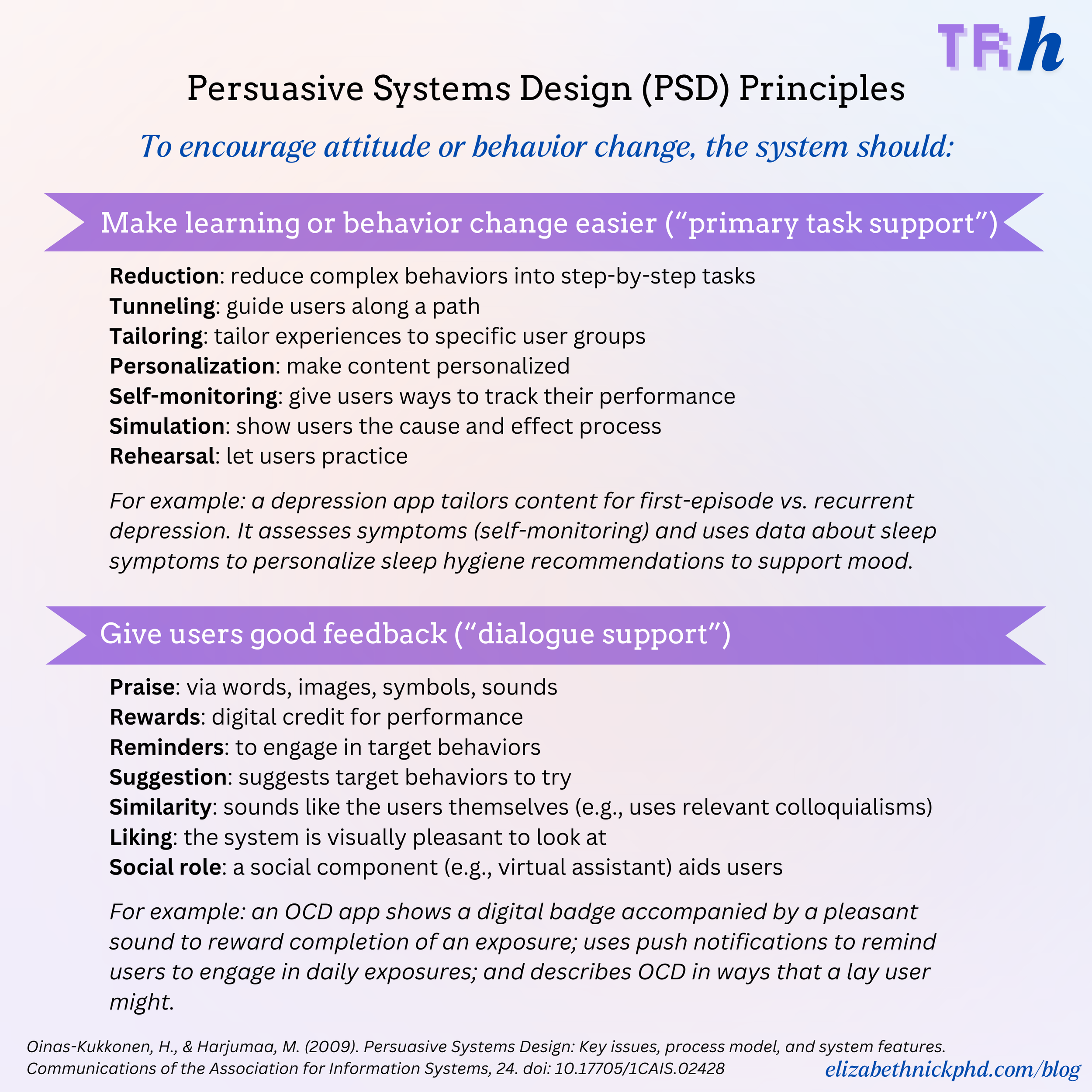
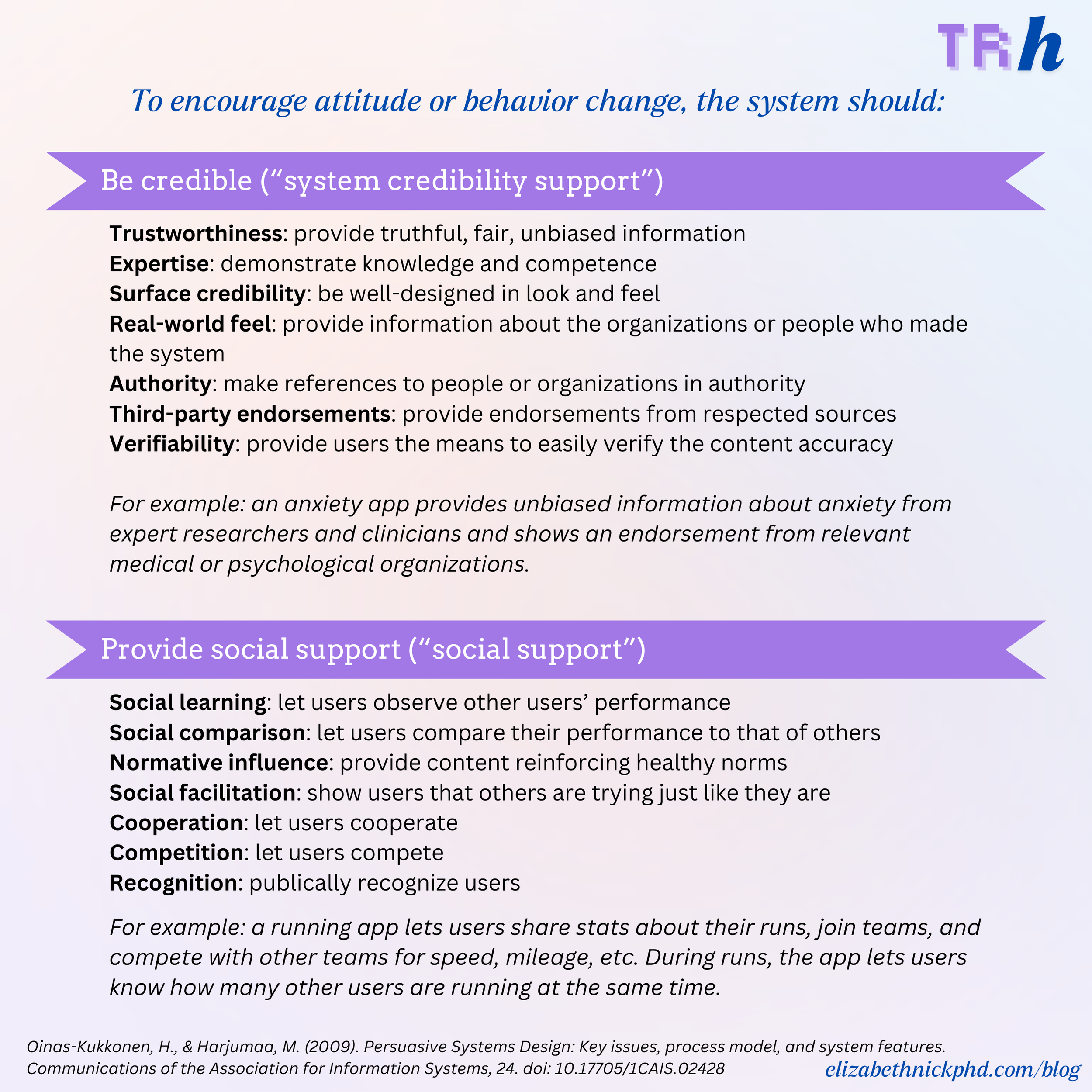
The idea of PSD seems quite logical to me: to help people change, an app or system should make learning easy and tailored, provide useful information and positive feedback, demonstrate its credibility, and involve some sort of social component. It stands to reason that more PSD features means more engagement, and more engagement (of some sort) means more app efficacy (symptom reduction).
For my fellow nerds
This sets up a potentially interesting set of relationships among PSD, engagement, and symptom reduction. For simplicity, let’s not get specific about which PSD principles, the types of engagement, or the symptoms in question. Let’s also assume that more use of PSD principles does increase engagement, and greater engagement does lead to more symptom reduction.
How might these three variables affect each other? Let’s explore a little mediation and moderation.
Mediation tells us how something works, or the “mechanism” that explains why one variable affects another. In this hypothetical, more PSD leads to an increase in engagement, which leads to better symptom reduction. That is, more successful use of PSD principles improves symptom reduction because of increased engagement.
Moderation tells us for whom something works. Here, PSD and engagement are more independent of each other. More use of PSD principles does not necessarily create more app engagement. Instead, in this model, users who engage the most and whose apps use more PSD principles would be expected to see the greatest symptom improvement.
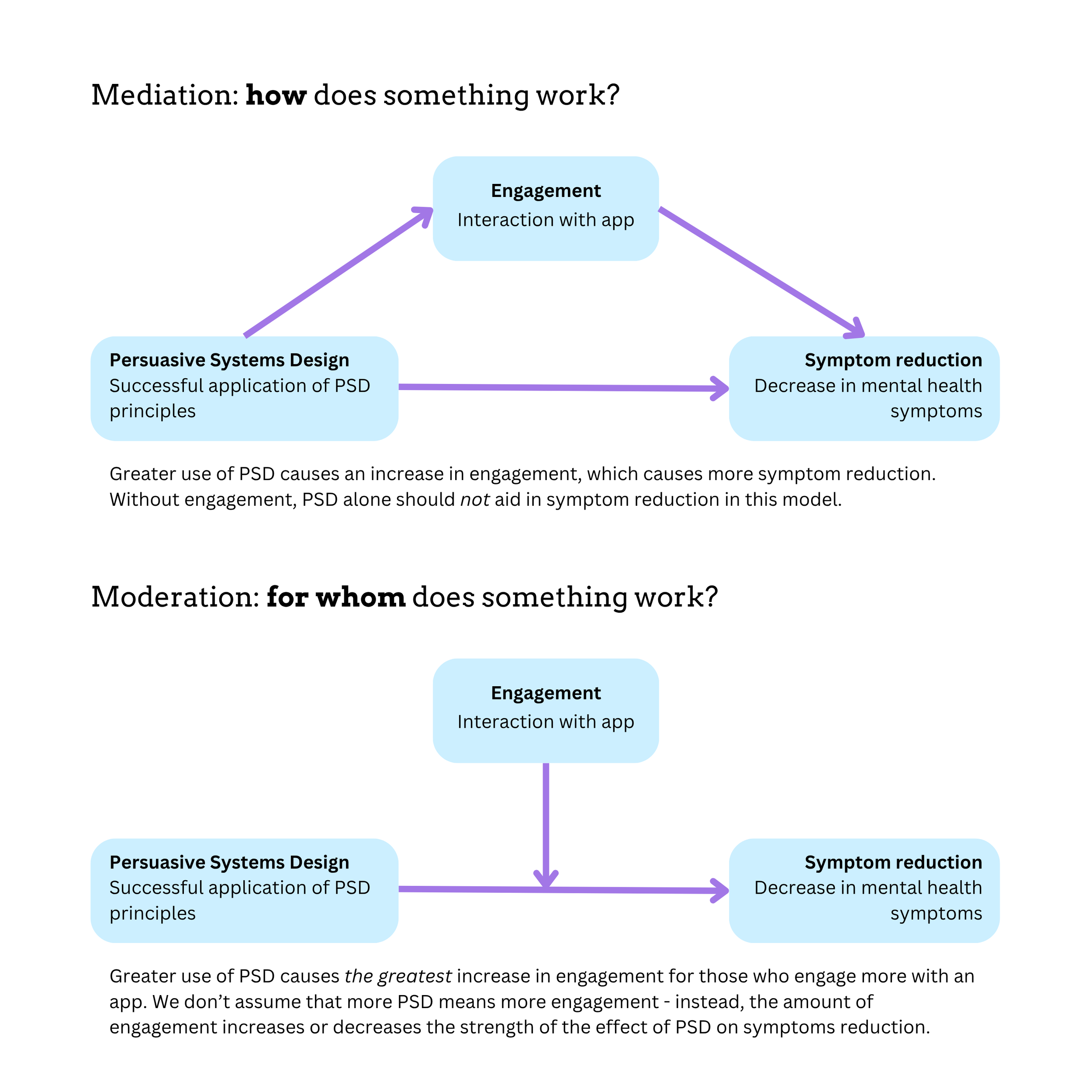
Let’s dig a little deeper with some hypothetical examples.
“App A” uses very few PSD principles. “App B” uses many.
Mediation: Users of App A generally engage very little. As a result, they experience very little symptom reduction. Users of App B generally engage a lot, and as a result, they experience much better symptom reduction.
Moderation: With App A, it doesn’t really matter how much a user engages - the symptom reduction will always be relatively small. With App B, users who engage a little might experience a moderate amount of symptom reduction, and users who engage a lot might experience a ton of symptom reduction.
So which model is correct in the real world? Are we missing any other important variables? This is a hugely complicated question - but one we’ll continue to explore!
