Gamification and nudging
In this new series, I’m exploring psychology and tech by highlighting exciting recent research.
What are gamification and nudging?
Gamification is a highly popular method to increase users’ engagement in mental health (and other) apps, presumably to increase symptom reduction. The types of gamification we might be most familiar with include progressing through increasing levels of difficulty, collecting badges or experience points, viewing leaderboards, and using the app daily to avoid losing a streak, as in Duolingo, whose owl mascot encourages and cajoles its users to defend their streaks by continuing their language lessons.
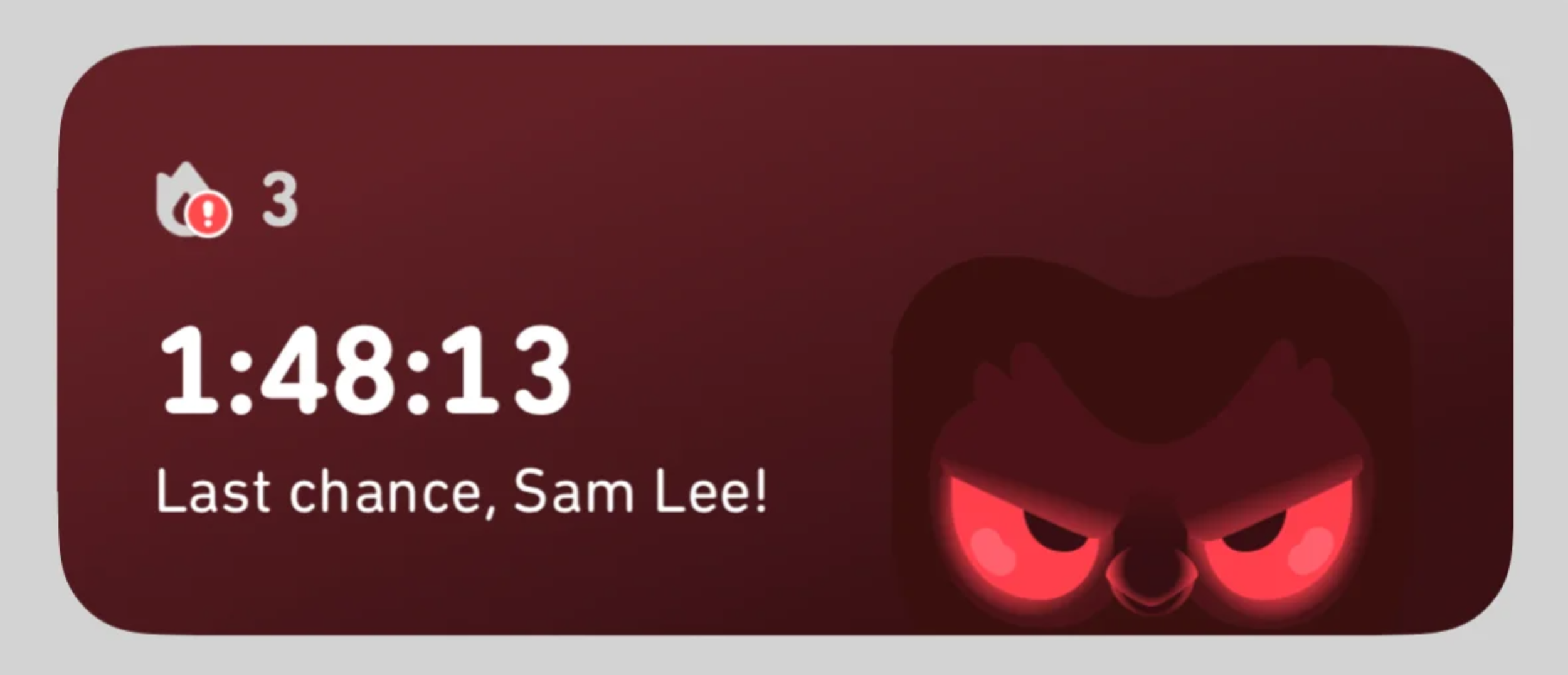
Menacing 2026 Duolingo screenshot, sourced via Mobbin
Technically, according to the research I’m reviewing today, avoiding a streak loss is a “nudge,” which indirectly reinforces users’ positive behaviors through choice-making. Although in the case of Duolingo, I’d be inclined to call the push notification above a “threat.”
What does the literature say?
Lots of mental health apps use gamification and nudging, but the jury is out on which techniques work best in the mental health space, and whether “more is more” - does more gamification and nudging equal more engagement?
Auf et al. (2021) addressed these questions with a very cool study! First, they reviewed the literature, identifying 13 gamification mechanics and 13 nudge techniques, some of which include:
Gamification mechanics: progressing through levels, unlocking rewards, earning badges, customizing an avatar, providing a leaderboard, or giving a user a “quest”
Nudge techniques: self-monitoring features, reminders, simplification in design and navigation, having users commit to activities in advance, making a healthy activity recommendation a default (but still providing choice to opt out), or loss aversion (“don’t lose your streak!”)
Then, pulling use data from SimilarWeb, they explored engagement metrics in early 2020 for the 50 most popular mental health apps on the Google Play store. These metrics included user retention in the first 1-2 weeks after installation, sessions per day, and time of use per day. The authors dug deeper into associations between gamification/nudging and engagement metrics among the 14 apps with the very highest engagement.
Initially, the authors found no relationship between the number of gamification mechanics / nudge techniques and overall engagement. There was no clean, numeric connection here - according to these data, more is not more. Stuffing apps with as many gamification and nudging features as possible is no guarantee of engagement success.
What I love about this study is that the authors then consulted ten experts about the apps with the highest engagement. This qualitative component could answer questions that an initial quantitative component could not. Mixed methods!
If more is not more, what works?
The experts found that the top-performing apps had a unique mix of gamification and nudging features that set them apart from their competitors. Weirdly, I would liken this result to soup recipes. Special combinations of ingredients make for really excellent soups. Putting EVERY ingredient in a pot, however, probably does not make for a high-quality soup. So which recipes won?
First-week user retention: Headspace performed best here, holding onto 28% of users on day 7 compared to the average at 7%. Its “recipe” included simplification of the onboarding process, personalized avatars, a meditation progress bar, and a “core loop” interaction (repeatedly watering a seed and watching it grow). The authors also noted a “default nudge” early in onboarding, which encourages (but does not force) users to get straight to meditation ASAP, as shown below:
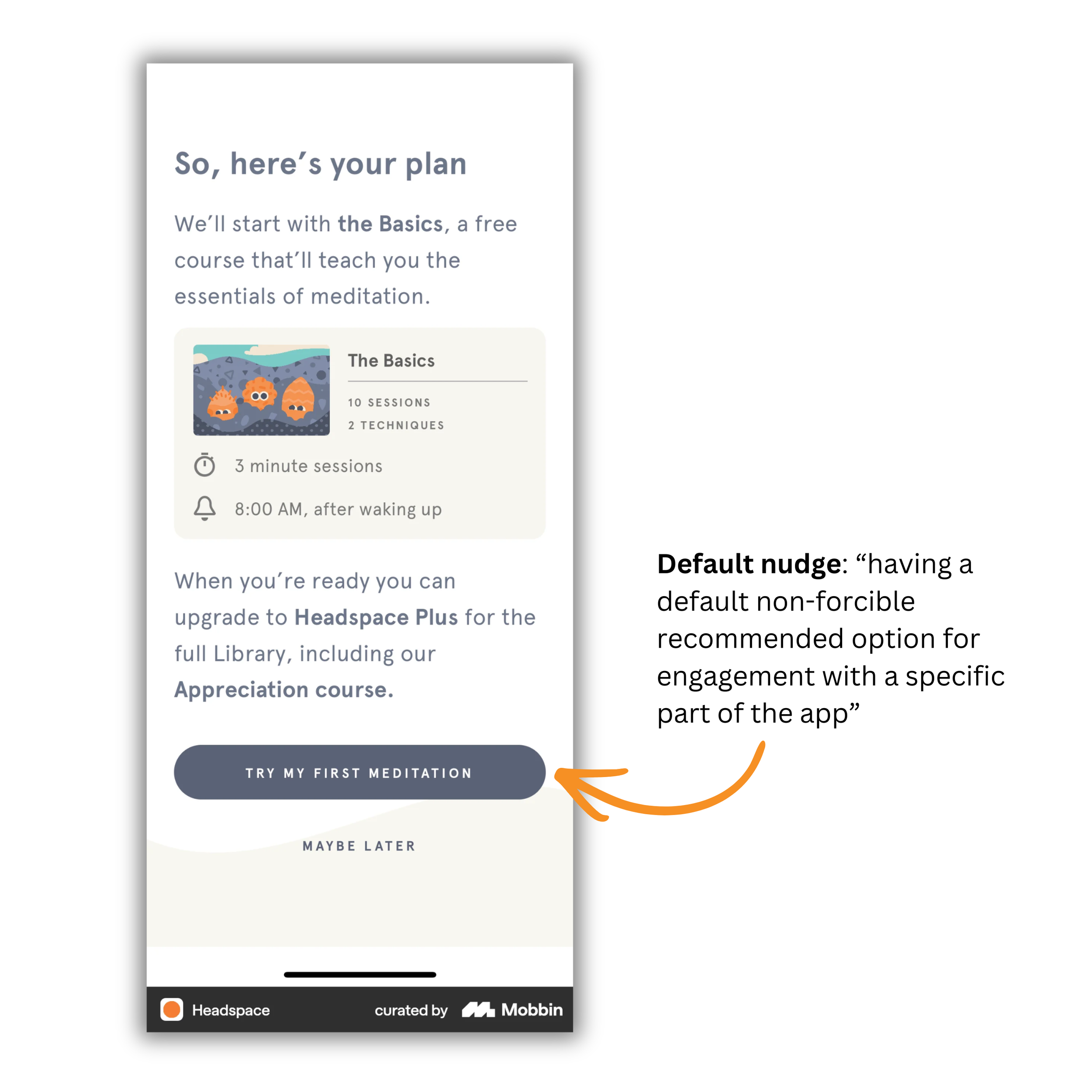
2019 screenshot of the Headspace app, sourced via Mobbin
Daily duration of use: although some other apps performed well in this category because of their social component, Calm stood out. Even without a social feature, Calm users engaged for 20 minutes per day on average, compared to the overall average of 7 minutes. Calm’s recipe included clarity (even in the name - the Calm app makes you Calm), simple UI, and 10-15 minute meditation sessions. The visual look was also aligned with the use of the app: calm and relaxed, as shown below:
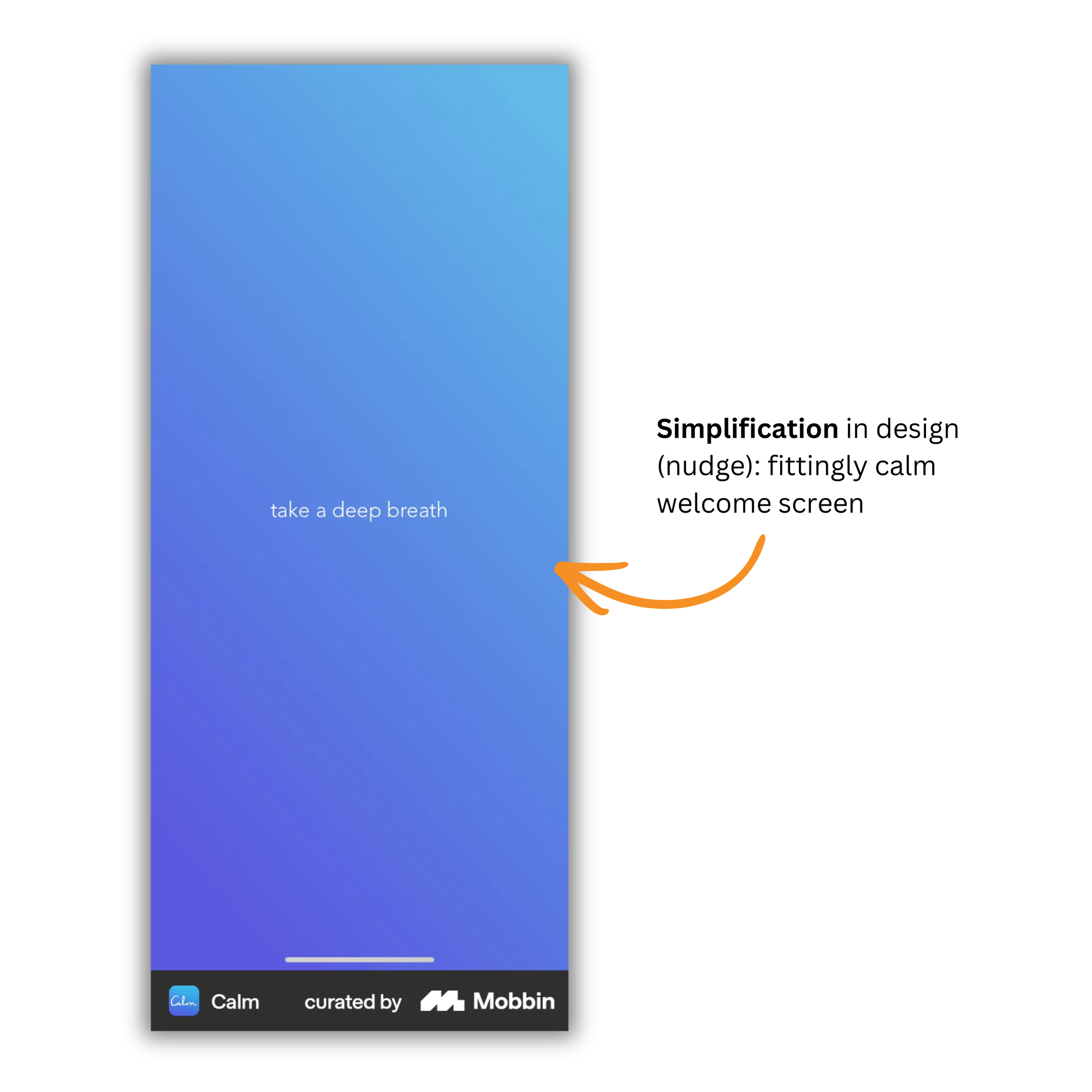
2020 screenshot of the Calm app, sourced via Mobbin
Number of sessions per day runner-up: Stop, Breathe & Think (RIP) engaged users 4.42 times per day, compared to the average at 1.7. I LOVED this app so much and I would recommend it to kids and families all the time. The authors noted that SBT got to user needs fast via personalization. As shown below, users could start every session with a very brief assessment of their physical and emotional states if they wished. The app would then recommend mindfulness activities based on users’ answers, and users could select and activity and start immediately. Quick, personalized, effective - seems like an excellent recipe to me!
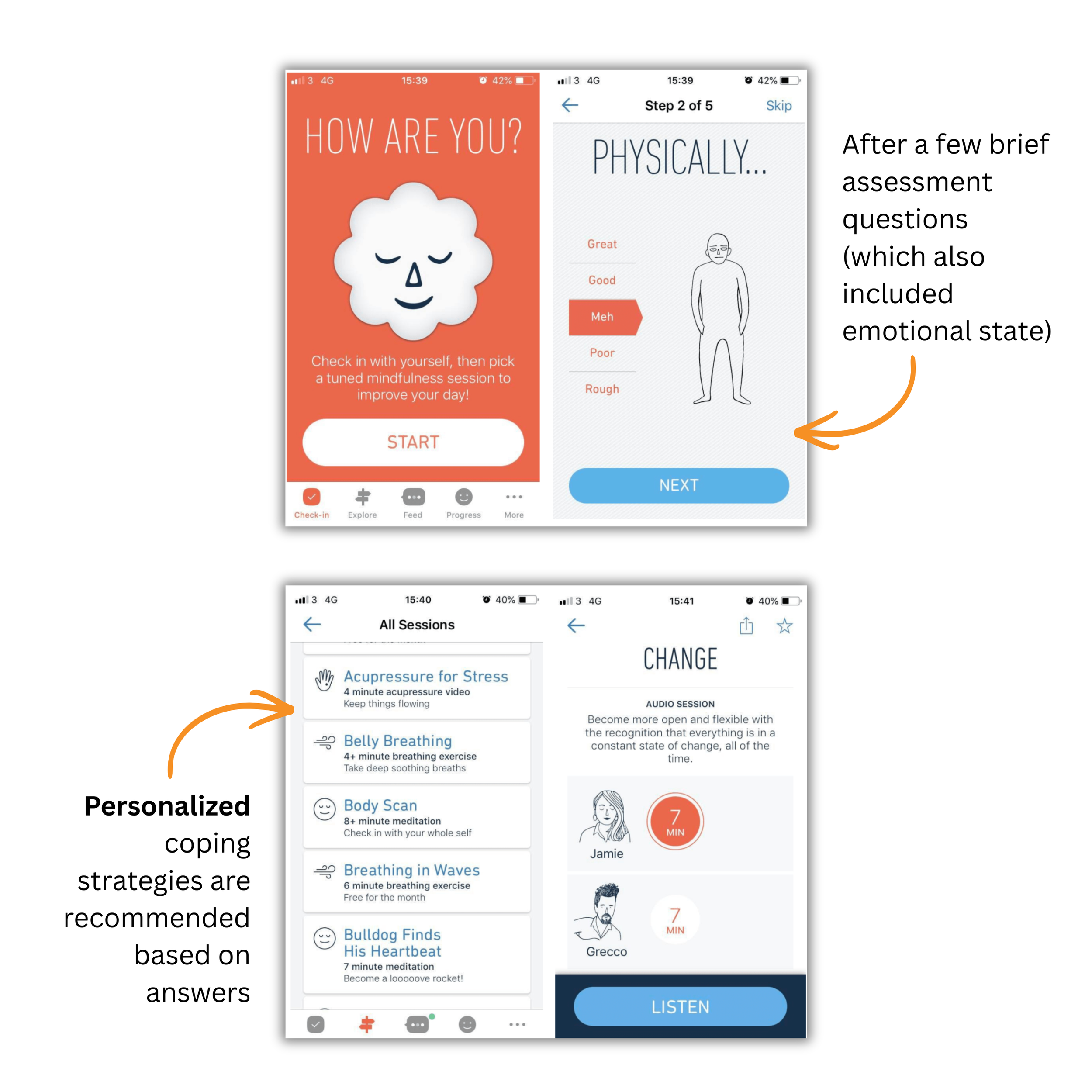
2019 screenshots of the Stop, Breathe & Think app, sourced via surfandunwind.com
Number of sessions per day: Replika is a very interesting one. When it was launched, Replika marketed itself as a psychology-informed mental health chatbot, which could provide users with a supportive digital friend. Replika has changed over the years (at times in very controversial ways). However, at the time of this study, it was closer to its original form, and users in this sample engaged 5.96 times per day. Like SBT, Replika also would respond very quickly to users’ needs, this time via its chatbot. Its unique recipe also included XP, levels, customizable avatars, and customizable chatbot avatars, as shown below:
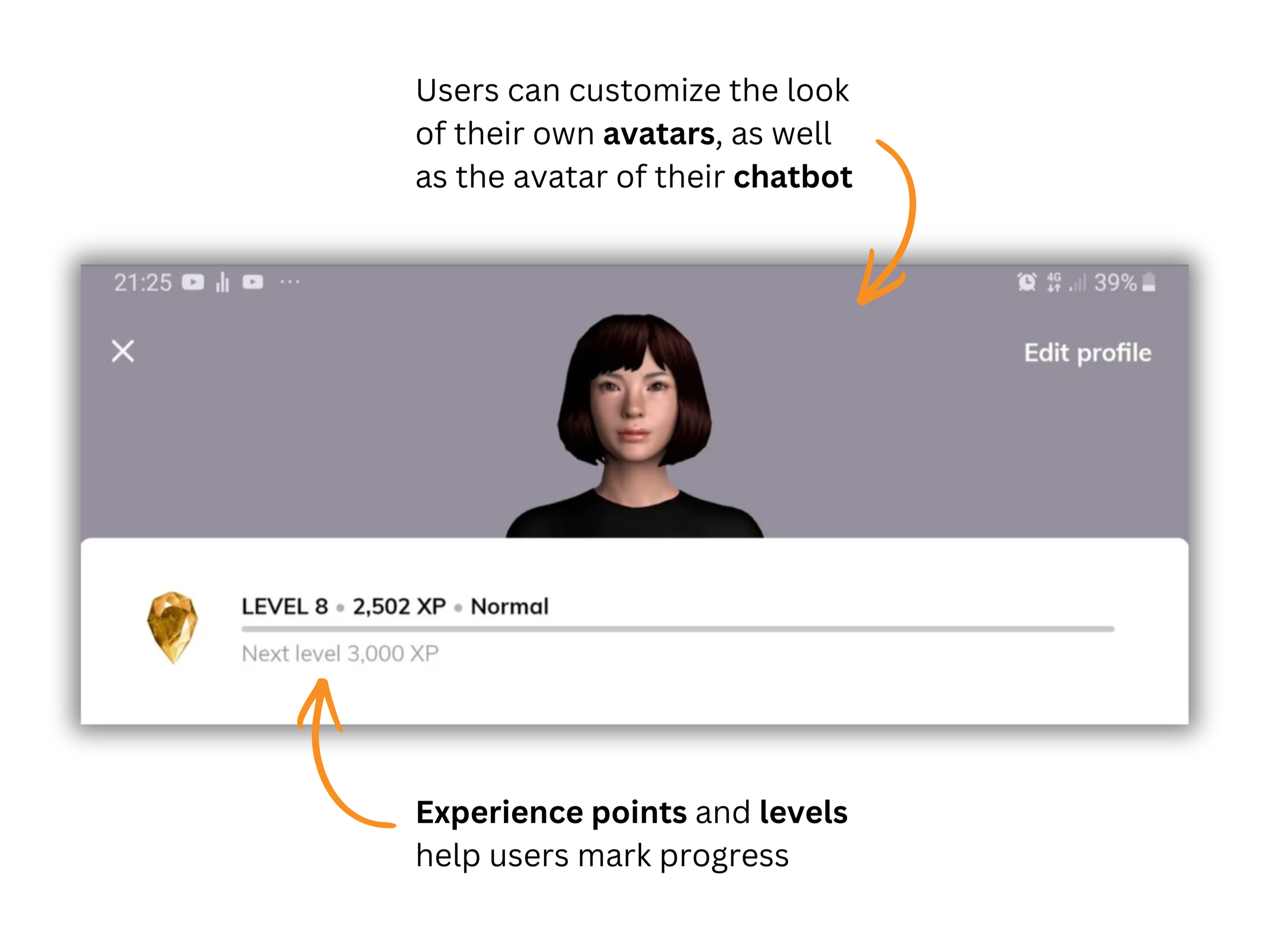
2020 screenshot of the Replika app, sourced via r/Replika on Reddit
Take-aways
The authors conclude that app creators need to design with intention. Gamification elements should be added for a reason - preferably one connected with a desired health outcome. Because nudges can have different effects on different users (e.g., with Headspace’s early meditation default, “ooh, that sounds like a great idea” vs. “let me explore the app first”), evaluate their performance rather than assume they will work. Personalize experiences in ways that matter. Essentially, don’t add gamification or nudging features merely for their own sake. To return to the recipe metaphor, if you’re going to make Italian wedding soup that you hope people will buy and enjoy over and over, don’t throw in truffles and saffron just because they’re fancy. Make sure that your ingredients play well together and each is there for a reason.
For my fellow nerds:
Something that’s been pretty cool about this process of reviewing this literature is getting to know our disciplinary “next-door neighbors” better. While I live in the “clinical psychology house,” so to speak, there are other houses at the intersection of human experiences and technology, and their literature can be quite different.
For example, the study reviewed today comes from an international conference on engineering design, written by a team of researchers in health and design. The 13 gamification techniques come from the Mechanics, Dynamics, and Aesthetics (MDA) framework in game design, taught at a game developers conference. Nudge theory comes from behavioral economics. Other literature I’ve explored over the years comes from the human-computer interaction (HCI), human-centered design (HCD), and participatory research bodies of literature. In academia, unless we’re intentional about it, we can become homebodies, so to speak. There is a lot of power and perspective that comes from getting to know your neighbors!
