🔔 Notifications
In this new series, I’m exploring psychology and tech by highlighting exciting recent research.
Hey! Look! Listen!
As a lifelong social media lurker (Millennial Facebook habits circa 2010 notwithstanding), most of the notifications on my smartphone are from the family group chat. Even if I posted more often online, though, I suspect I’d keep my notifications limited. It’s hard enough getting a handle on my smartphone use without Instagram or LinkedIn purposely pulling at my attention. However, limiting notifications might not have the effect on screentime that we previously thought.
Does turning off notifications actually change how we use our phones? Even for people with intense FOMO?
To explore these questions, Dekker and colleagues (2024) conducted a robust* experiment: log users’ actual daily smartphone use for one baseline week, then direct some users to turn off all their notifications and log everyone’s daily use for a second week. Throughout, they asked all users questions about how in control they felt over their phone use.
Most of us would guess that compared to the control group, those who turned off their notifications (the intervention group) would check their phones less and log less screentime - unless they were unusually worried that they would miss something important (high FOMO).
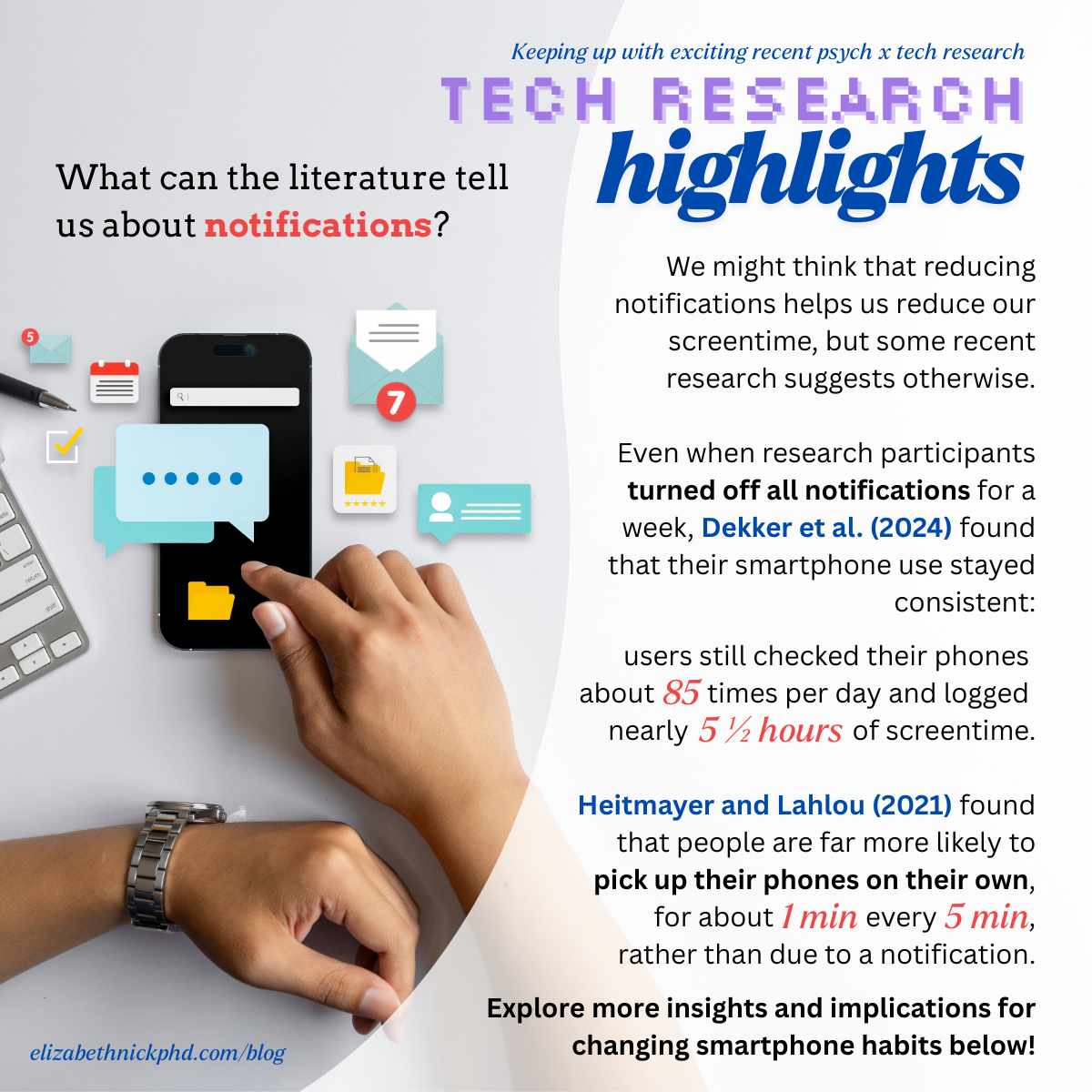
Surprisingly, people in the intervention group went on checking and using their phones the same amount, even with notifications turned off. On average, this group still checked their phones about 85 times per day, and logged nearly five and a half hours of screentime per day - no change from their own baseline week or difference from the control group. Intervention group users didn’t feel more in control of their phone use as a result of turning off notifications, either - but they did feel they were missing out on what was going on online.
These findings kind of turn our assumptions about notifications upside down. It might not be that more notifications drive more smartphone use. Rather, the authors suggest, notifications might just naturally accompany greater use. That is, people who use their apps and phones a lot might just get more notifications as a result.
So what drives smartphone use, if not notifications?
One of my favorite studies of the last few years got at this question in a cool way. Heitmayer and Lahlou (2021) gave participants small cameras mounted to eyeglasses to objectively record their natural daily smartphone use. The researchers and participants then watched the footage back together to discuss important moments and gather more detail and subjective context.
Phone use varied a lot, but on average, participants picked up and used their phone for about one minute, every five minutes. And the vast majority of this use was user-initiated - that is, 89% of the time, the user picked up their phone of their own volition, not as a result of a notification.
Participants reported that picking up their phones felt automatic. One participant said, “seeing [the footage] has made me realize that I don’t even remember picking it up - I think I use it a lot more than I let myself believe” (p. 5). Another participant reported that despite turning off notifications, “I find myself checking more regularly to see whether something’s come up” (p. 5). The researchers observed that even though users find notifications disruptive, it’s the “habitual, internal self-disruptions” (p. 9) of automatic phone checking that are bothersome - and far more frequent.
What does this mean if we want to change our phone use habits?
Changing our phone’s notification settings might not actually be that effective, even though that solution seems intuitive. At this point, it appears that rather than being dragged back into our phones by the vibrations and dings of notifications, we’re habitually reaching for them and jumping back in on our own. The problem is, we’re likely doing that more, and more automatically, than we realize.
I don’t think this is some sort of moral failing or psychological weakness on our parts. Our devices and apps are purposely designed to grab and hold onto our attention. There are definitely phone-based ways we can fight back, like apps or devices that stringently control screentime.
However, I think mindfulness may be even more important here. We need to notice our own urges to check our phones because we’re feeling bored or avoidant. We need to look up in the middle of an endless scroll and notice whether we actually feel more amused, relaxed, or connected, rather than just numb. A meta-analysis supports this idea, too: across 30 studies, Ru et al. (2025) found that greater mindfulness is associated with less problematic smartphone use.
Mindfully using our phones is FAR easier said than done. But there was a time that many of us survived on flip phones, landlines, and other “analog” tech. I am deeply curious about what Gen Alpha and others born after the advent of smartphones think and experience when it comes to habitual or problematic device use.
Next time: dipping our toes in mental health app meta-analysis
More details for my fellow nerds
Dekker et al. (2024): Preregistered RCT of 205 Android users ages 18-30 (mean age 24.45, SD = 3.92), 52% female. 91 in control group, 114 in intervention group. Objective measurement of smartphone checking, screentime, and notifications via the Murmuras app. Subjective measures included baseline measures (e.g., trait FOMO) and repeated daily diary measures (e.g., single items on perceived overuse, control, smartphone distraction, FOMO). Linear mixed models with ML estimation; weeks (including aggregates of daily data) nested within participants.
What’s cool about this study? As an RCT, this study powerfully minimizes bias (see below). It also uses an objective measure of smartphone activity, which has been largely lacking until recent years. This is important because our subjective estimations of our own smartphone use are often way off! They also used a multilevel statistical model. Although their main analyses aggregated daily data into weekly data, exploratory analyses took full advantage of the rich variability captured by their design, revealing small, significant linear decreases in some subjective measures day-by-day hidden at the week level. As they mention, more intervention time allow for more effects to reveal themselves.
Heitmayer and Lahlou (2021): Study of 37 participants, most European, ages 21-29, 43% female. Objective measurement of smartphone use via in-vivo video “subcam” mounted on eyeglasses for at least 3 consecutive days, creating at least 5 hours of video material. Subjective Evidence-Based Ethnography (SEBE) involved reviewing footage with researchers and answering questions (Replay-Interviews). Qualitative themes derived from qualitative content analysis. Subfilms were coded for duration of use, notification type, activity type, social context, etc.
What’s cool about this study? This study also uses an objective measure of smartphone use. By using in-vivo video, the authors captured so much more about the context of smartphone use than studies usually do - and they conducted qualitative interviews with the participants for even more context. It’s rare and exciting when both quantitative and qualitative techniques are used like this. The nature of the study makes for a small sample size, but a huge amount of rich data.
* The authors conducted a randomized controlled trial (RCT). RCTs randomly place people in a control group or an intervention group, which minimizes bias. If people got to choose which group they were in, the intervention might seem effective, but not because it actually works - instead, because people who really wanted to change their phone use chose to be in the intervention group, and people who didn’t chose to be in the control group, for example. This means that motivation would be the “third variable” that muddies the waters.
